

Many people in IT use agile principles and frameworks like Scrum without asking ‘why’. But acting agile is in fact an answer to the complex environments we are working in nowadays.
Two centuries ago, our workplaces were often huge factories which required plain man power from its workers. In the last century engineering in complicated projects became important, where brains of the employees became important. But especially since the rise of the internet or work has become more and more complex. Some people say we already live in the VUCA world.
Probably the famous example for the shift from complicated to complex is the crisis of software development in the 1990s which resulted in the agile manifesto.
To understand the different areas between simple, complicated and complex, the stacey matrix delivers a good explanation. But what are best practices to act within the different environments? Here you can have a look atthe Cynefin framework by Dave Snowdon which gives a good introduction into best practices respectively:
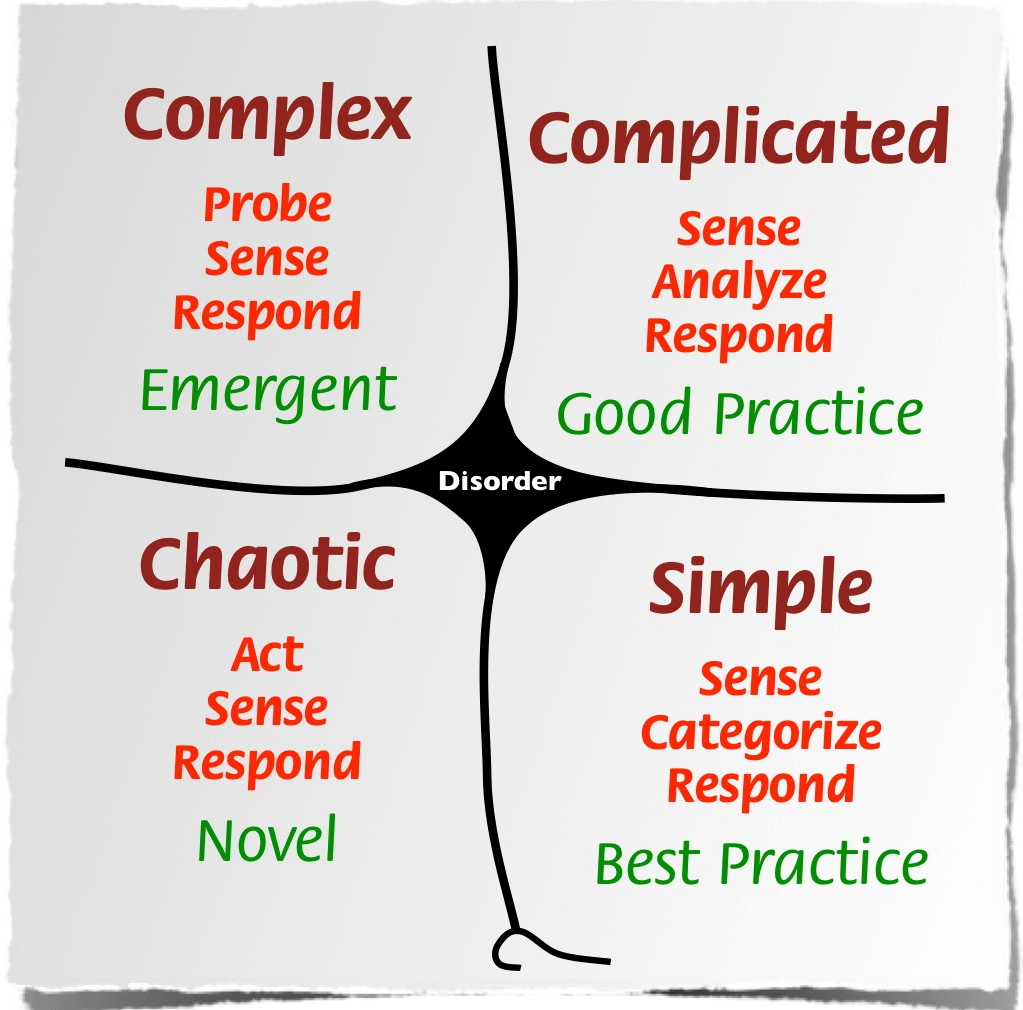
So acting agile is an appropiate response to the complex challenges of our working environment. The most famous slogan behind agile is probably “inspect and adapt”, similar to the ‘probe sense respond’ pattern in the cynefin framework. It has found its manifestation as the PDCA Cycle.
But anyway, since when, and why, did the world get so complex?
Today, products and services often rely on many parts, which themselves consist of many components. All these parts are in constant change (e.g. libraries, platforms, processes), requiring constant adaptation. Furthermore most of our work involves ongoing communication between human beings (who are complex in themselves), so the information within the project has to be updated frequently. Good teams try to build and update a shared mindset in order to understand the whole complexity of their environment.
Unfortunately most of us spent too many years in a useless institution called ‘school’. Here we were taught a simple and complicated mindset, instead of developing important skills like creativity, collaboration or direct communication. We deliver exactly what our boss (teacher) has told us, otherwise we get eventually dismissed.
Furthermore, living in a world of increasing uncertainty (the key mark of complexity) where we often can’t understand the cause and impact of a situation, results in insecurity and fear. We have to admit that we often act in uncertainty, even encountering unknowns of different order.
A longing for control or reduction of complexity is understandable, but reduces the interaction with the environment. So to actually interact with a complex system like the market, we need to increase our internal complexity, which feels counterintuitive at first sight.
Helpful elements to cope with complexity in work could be:
- Supply vision, goals and direction, be willing to negotiate and adapt them
- Value leadership over management
- Support collaboration of team in rooms (onsite or virtual), use less chat or email
- Enhance your shared mindset by using techniques like pair programming
- Encourage complex decision making like consultative delegation
- Let go of control illusion, welcome uncertainty by e.g. switching in project sprints from commitments to forecasts
- Moving from bloated central headquarters to small divisions supports faster and better decisions for the customer
- Install mutual feedback loops for inspect and adapt
- Build trust by integrity and sincere communication
- Foster a culture of learning by failures and success
- For adaptive decisions use principles rather than rules.
Work in complex environments requires new qualities: we have to give up control — better said the illusion of control. Frequent feedback cycles, willingness to learn from failures and successes is crucial (‘fail fast, fail often, fail cheap’).
 Albrecht Günther
