
Handling complexity
Why trust?
In the dynamic and complex world of nowadays, we have to face many ambiguous situations where we hardly understand the reasons or are unable to implement a lasting solution. Our ‘need for closure’ often results in an illusion of control. Another form of reaction is trust.
What is trust?
“Trust is something I feel.” would probably be the most common answer you get asking people on the street what trust means for them. And yes, getting aware that the presence of trust often results in warm, expanding body sensations.
A common definition of trust is “the willingness of a party to be vulnerable to the actions of another party based on the expectation that the other will perform a particular action important to the trustor, irrespective of the ability to monitor or control that other party” (1).
According to the philosopher Niklas Luhmann, trust is a mechanism to reduce social complexity (2). For me, trust is a forecast. I have a knowledge base about another person, and from there I can somewhat forecast their behaviour.
We inherently want to trust in our life. We have a longing to overcome our fears. One common method to avoid fear is enacting control. The other one is to start trusting.
We often use signs of trust in daily life, e.g. showing an open hand while waving or before greeting, has the original meaning, that “I don’t have a weapon in my hand”.
Most of the time we are not aware that our actions are built on trust. You assume that the cashier will accept your money. And how do you know that the floor you are standing on will carry you? You assume the shop trusts in your money and the architect of your house did a good job.
If we don’t have enough data as a base, we tend to rely on a trustee — a “ring of trust”: if my friend trusts another person, I will trust him / her. An example of a more formal trustee is a solicitor.
But be aware — there is a balance of trust. Blind trust is as damaging as no trust at all. And you will find out that the ability to trust others is connected to your self-confidence.
Trust is reciprocal: Since we often follow the economic pattern of “tit for tat” — if someone trusts us, we mostly trust them, too. But the same goes the other direction: if someone mistrusts us, we also start to be suspicious.
“Self-trust is the first secret of success” (Ralph Waldo Emerson)
Aspects of trust
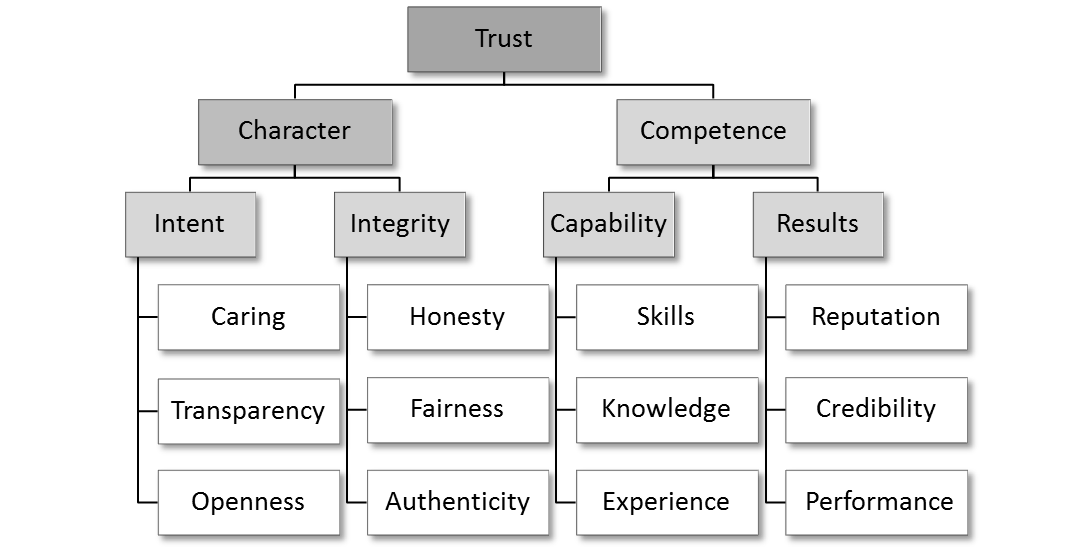
Trust is based on many components, mainly divided into character and competence. To display the different aspects of trust, Richard Barrett developed the trust matrix (3)
The economy of trust
If we don’t trust, we start to aim for control, e.g. by creating endless contract files in order to define every possible aspect of collaboration in a project. And we get defensive, adhering to rules and laws. We tend to blame and to punish.
Signs of missing trust in a team could be observed in their meeting culture:
- too many meetings (or hardly any), either too short or very lengthy
- Frequent discussions without a result
- Focus on form, rules and hierarchy
- Punishment of mistakes instead of collective learning
- Crucial topics or questions are dealt with outside of the team
- Individual blaming instead of inspecting the systemic issue
But in the dynamic and complex world of today, rules and penalties hamper productivity. A lack of trust ultimately costs time and money, and eventually innovation. Patrick Leoncini mentions in his book “the 5 dysfunctions of a team” the absence of trust as the first pattern (4).
On the contrary, performative teams with a high level of trust among themselves
- are far more effective in their communication and action
- increase productivity by delegation and inspect & adapt patterns
- foster resilience by welcoming diversity of opinions and emotions
- are willing to take risks, thus leading to more innovation
- offer and seek help within the team and outside
- use mistakes as an opportunity to learn and improve
Broken trust
But what should we do if our trust in others is broken? According to Game theory, it is smart to follow the ethic of a “second chance”. Reinhard Sprenger talks in his book (5) about how to deal with broken trust. He recommends offering cooperation in first place, and if responded to — continuing it. If the trust however is broken, punish it immediately. After a while, be placatory and offer cooperation again. If then not responded to, finish the cooperation for good.
How to gain trust
So what can I do to gain trust in my team? In my experience, these actions are useful:
- Be authentic: your words, voice, face and posture are aligned and congruent
- Be imperfect by admitting own errors in first place
- Show your vulnerability by sharing difficult moments
- Share about yourself and your life, expanding your personal canvas
- Ask for feedback and report back how you dealt with the feedback
- Address conflicts in a constructive way, seek and offer support
- Practise active listening in your conversations
- Demonstrate reliability: Consistently deliver on your commitments. By meeting deadlines and fulfilling promises, you show your team members that they can rely on you.
A team is not a group of people that work together. A team is a group of people that trust each other.” (Simon Sinek)
What can you do as a company to gain trust from your clients?
- Foster collaboration and communication over contracts
- Be reliable, deliver what you promised, over and over again.
- Admit mistakes and share them as soon as possible, offering learnings and workarounds
- In case of a conflict: offer an ombudsman outside of your power to resolve the conflict.
- Offer trust in advance like the prevention of a vendor locking or the option for the customer to resign on short notice
Conclusion
In the ever-evolving landscape of collaborative work environments, trust remains a non-negotiable pillar for team success. It underpins effective communication, boosts collaboration, and paves the way for innovation. By fostering trust through reliability, open communication and support, team members can create an environment where everyone feels valued, respected, and empowered. Remember, trust takes time to build, but the dividends it pays in terms of team cohesion, creativity, and achievement are immeasurable.
Further Reading
Steven M. R. Covey: The speed of trust, Simon & Schuster 2006
Quotes:
(1) Roger C. Mayer et. al.: An Integrative Model of Organizational Trust, The Academy of Management Review, , Vol. 20, №3 (Jul., 1995), pp. 709–734
(2) Niklas Luhmann: Trust and Power, Chichester: Wiley, 1979
(3) https://richardbarrettblogdotnet.wordpress.com/2014/04/11/building-trust-in-your-team-the-trust-matrix
(4) Patrick Leoncini: The 5 dysfunctions of a team, Jossey-Bass 2002
(5) Reinhard K. Sprenger: Trust: The Best Way To Manage, Campus 2002
 Albrecht Günther