
If you are working in complex environments, you are probably familiar with the Stace matrix. So writing about this pattern might be like to carry coals to Newcastle 🙂
Developed by Ralph D. Stacey, the Stacey Matrix is a conceptual model that categorizes projects based on their level of certainty and agreement among stakeholders. It consists of four quadrants:
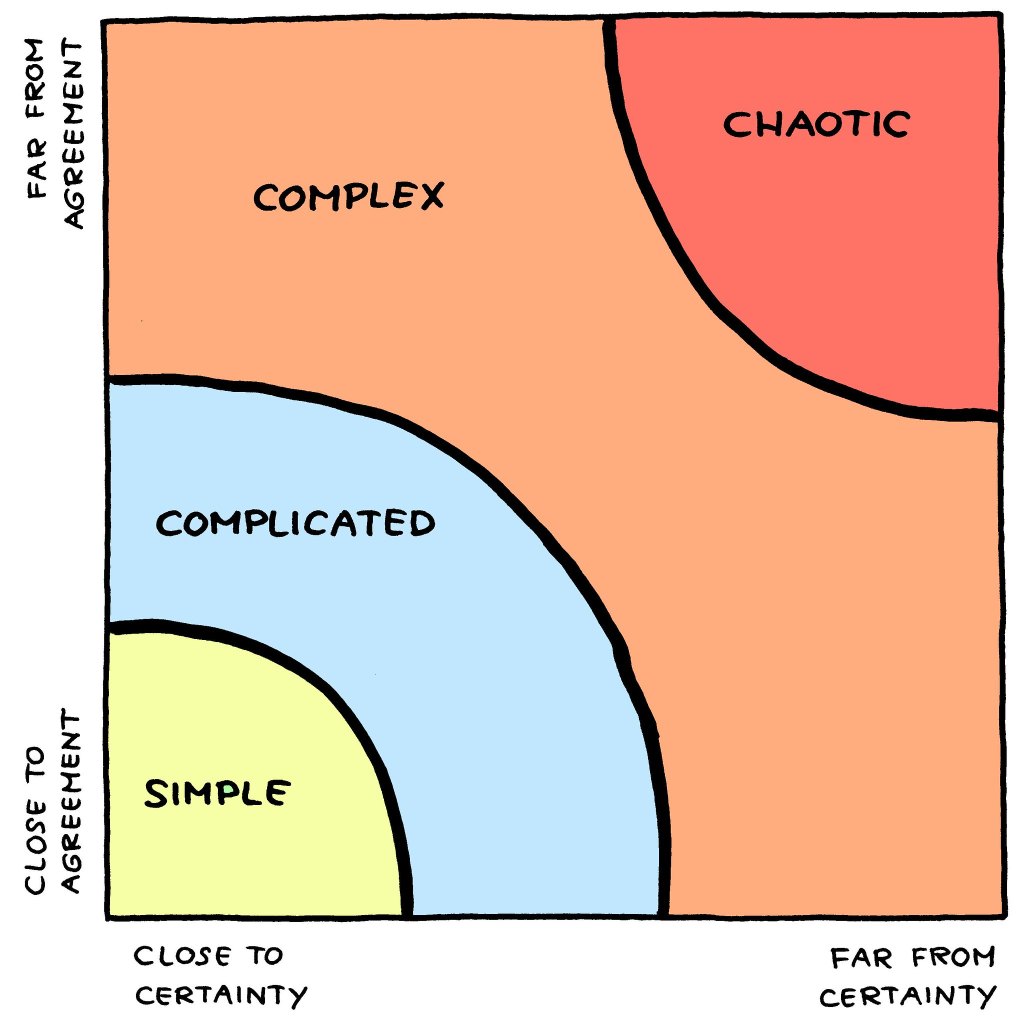
- Simple: These projects have high agreement among stakeholders and clear cause-and-effect relationships. Solutions are straightforward, and outcomes are predictable.
- Complicated: In this quadrant, there may be multiple solutions, but cause-and-effect relationships are still discernible with expert analysis. Stakeholder agreement may vary, but the path forward is achievable through expertise and effort.
- Complex: Complex projects involve multiple stakeholders with diverse perspectives and unclear cause-and-effect relationships. Solutions emerge through experimentation and iterative approaches rather than predetermined plans.
- Chaotic: Chaotic projects lack agreement among stakeholders, and cause-and-effect relationships are unpredictable. Immediate action is necessary to stabilize the situation before moving forward.
 Albrecht Günther