
If you believe this pattern just applies in therapy: it happens in teams and organisations. All the time. And we don’t notice it. so having the drama triangle in mind, can solve many stuck conflicts at work.
In work teams, navigating interpersonal dynamics is essential for fostering collaboration and achieving common goals. However, when communication breaks down and conflicts arise, teams may find themselves trapped in what psychologists call the Drama Triangle. This framework, developed by Stephen Karpman, illustrates three roles that individuals may adopt in dysfunctional relationships: the Victim, the Persecutor, and the Rescuer.
The Victim perceives themselves as powerless and blames others for their predicament, often seeking sympathy and validation from colleagues. The Persecutor adopts an aggressive or critical stance, blaming and attacking others for perceived faults or mistakes. The Rescuer swoops in to save the day, offering unsolicited advice or assistance in an attempt to alleviate tension.
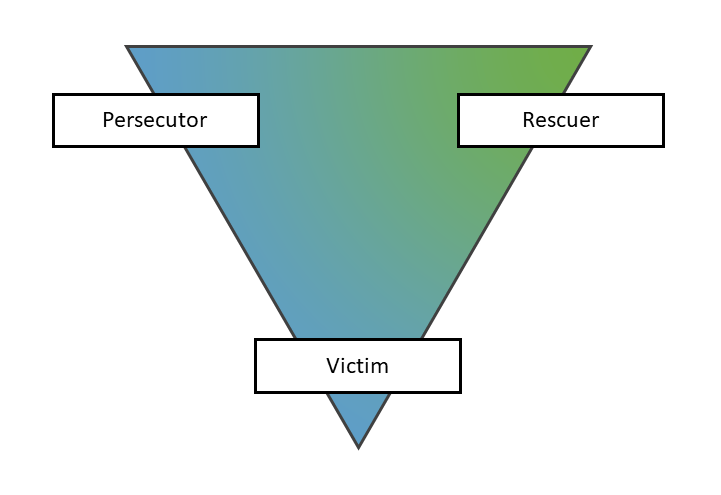
An example of the Drama Triangle in a work team might involve a project meeting where a team member, feeling overwhelmed with tasks, adopts the Victim role by expressing helplessness and blaming others for the project’s delays. Another team member, feeling frustrated, takes on the Persecutor role by criticizing the Victim for not pulling their weight. A third team member, eager to diffuse the conflict, assumes the Rescuer role by offering to take on additional tasks to help the Victim, thereby perpetuating the dysfunctional dynamic.
To break free from the Drama Triangle, teams must cultivate awareness of these roles and their underlying dynamics. By fostering open communication, empathy, and accountability, teams can shift from blame and conflict to collaboration and problem-solving. Encouraging a culture of constructive feedback and conflict resolution skills training can empower individuals to address issues directly and build trust within the team.
Sources:
- https://en.wikipedia.org/wiki/Karpman_drama_triangle
- Karpman, S. (1968). Fairy Tales and Script Drama Analysis. Transactional Analysis Bulletin, 7(26), 39–43.
- Agazarian, Y. M., & Gantt, S. P. (2000). Autobiography of a Theory: Developing the Theory of Living Human Systems and Its Systems-Centered Practice. International Journal of Action Methods: Psychodrama, Skill Training, and Role Playing, 53(1), 27–48
 Albrecht Günther
